
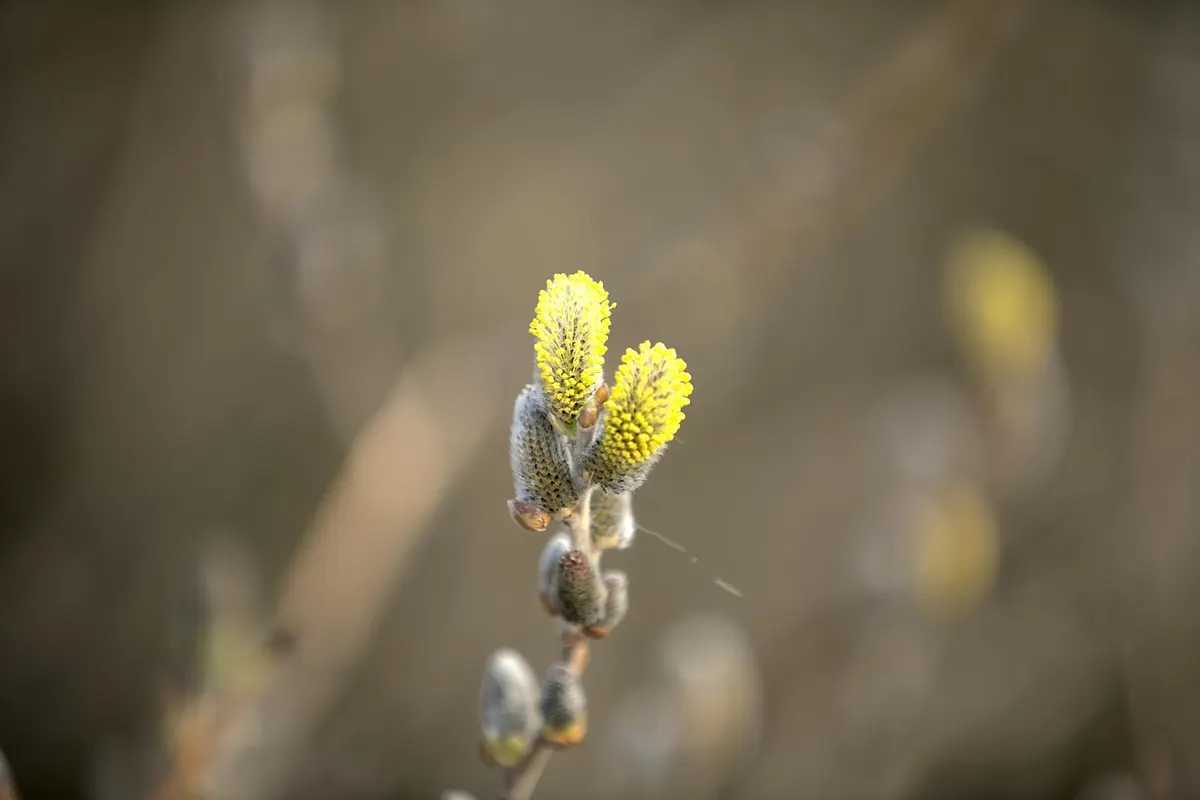
A willow earns its place in a small garden the moment you see catkins in February or leaves shimmering in a summer breeze. It also earns its reputation for taking over. Both things are true, and the difference between a willow that behaves and one that lifts your patio comes down to two decisions you make before you touch a spade: which willow, and where.
Get those right and the planting itself is straightforward. Here is how to do it properly when space is tight.
Choose the willow before you choose the spot
“Willow” covers a huge range of plants, from towering riverside trees to shrubs that fit neatly into a border. In a small garden, the variety matters more than the planting technique.
- Salix integra ‘Hakuro-nishiki’ — the dappled willow, usually sold as a standard with pink-tipped foliage. Easy to keep to around 1.5–2.5m with annual pruning.
- Salix caprea ‘Kilmarnock’ — the dwarf weeping willow, grafted onto a short trunk. Excellent in a pot or a small border, and generous with early catkins.
- Salix gracilistyla ‘Mount Aso’ — a compact shrub willow with fat pink catkins in late winter and grey-green leaves.
- Salix purpurea ‘Nancy Saunders’ — slender purple stems, blue-green leaves, and a plant that responds well to being cut back hard.
- Salix boydii — a tiny alpine willow for a trough or rock garden, slow and well-behaved.
Steer clear of the big ones unless you have room to spare: Salix alba, crack willow, and the large weeping willows sold as Salix × sepulcralis ‘Chrysocoma’ all want far more space than most gardens can give. If you have inherited one of these, or you are determined to plant one, speak to a qualified arborist before you do anything else.
Pick a spot with room to spare
Willows are hungry for light and thirsty for water. That second habit is what causes trouble, because their roots travel a long way underground in search of moisture.
As a general guide, keep a large willow a distance from buildings, drains and boundaries that is at least equal to its eventual height. For a small variety that is completely manageable. For a big one in a small garden, it usually is not — which is one more reason to choose a compact form.
Other things to weigh up:
- Sun. Most willows want at least half a day of direct sun. Light shade is tolerated; deep shade is not.
- Wind. Willow wood is brittle. A sheltered spot means fewer snapped branches and less shredded foliage.
- Boundaries. Crowns spread wider than you expect, and a willow leaning over a neighbour’s fence causes more bad feeling than almost any other tree.
- Patios and paths. Expect fallen twigs, catkins and sticky leaf litter. Plant upwind, not over the seating area.
- Access. Leave enough space to walk around the plant with a pair of loppers.
Prepare the soil properly
Willows are not fussy about soil pH and will grow in most ground, but they do best in moist, well-drained soil enriched with organic matter.
Dig a hole about twice the width of the rootball and no deeper than the pot it came in. Fork the base and the sides to break up compaction — worth the effort on heavy clay, where a smooth, polished hole can effectively trap roots. Mix the backfill with well-rotted manure or garden compost, roughly one part compost to three parts soil.
Skip the fertiliser. A handful of feed at planting encourages soft, sappy growth that the first autumn gale will wreck. If your chosen spot is genuinely boggy, plant on a slight mound so the crown sits above the water table rather than in it.
Planting, step by step
- Water the pot thoroughly an hour before planting so the rootball is damp right through.
- Dig the hole and fork the base as described above.
- Check the depth. The top of the rootball should sit level with the surrounding soil. Too deep is worse than slightly shallow — roots need air.
- Slide the plant from its pot and gently tease out any roots that have started circling the edge.
- Set the plant in place, backfill in layers, and firm each layer with your heel. Firm, not stamped on.
- Water slowly with a full can, wait for it to drain away, then water again.
- Mulch with 5–8cm of bark or compost, keeping it clear of the trunk.
- Stake only if you need to — a grafted standard or a very exposed site. Use a short stake and a soft tie, and remove it after two years.
Keeping willow roots in their place
An honest note first: no barrier reliably stops a determined willow. Root barrier fabric, installed properly in a deep trench around the planting hole, helps in a small space, but willow roots are capable of travelling well beyond it.
The reliable controls are gentler and cheaper. Choose a small variety in the first place. Water it consistently, so it has no reason to go hunting. Grow it in a large container — a 60–90cm pot or half-barrel of loam-based compost, top-dressed each spring — and it will stay contained almost indefinitely.
Then there is pruning. Willows are among the few woody plants that shrug off hard cutting. Coppicing or pollarding every second or third year keeps the top small, and the root system in proportion. It also gives you the best coloured stems and foliage.
If drains, soakaways or foundations are anywhere near your chosen spot, get advice from a qualified arborist or surveyor before planting rather than after.
The first year, and after
Water every seven to ten days through the first summer, and more often in dry spells or on sandy soil. A thorough soak beats a daily sprinkle every time. Keep the ground around the trunk weeded and top up the mulch each spring.
Aphids cluster on soft new tips, willow leaf beetles can strip foliage, and rust shows up as orange spots underneath the leaves. Damage is usually cosmetic on a healthy plant, so tolerate it where you can and pick off what you cannot.
Prune in late winter, before growth starts. A little sap bleed in early spring is harmless, just unsightly. For standards and coloured-stem varieties, cut last year’s growth back to a permanent framework each March — around 30–60cm of stem — to hold the size steady and keep the foliage bright.
A quick checklist before you dig
- A compact variety, not a riverside giant
- Half a day of sun and some shelter from wind
- Clear of drains, soakaways and foundations, with room for the mature size
- Soil improved with compost, no fertiliser
- A plan to water well for two summers and mulch every spring
- Loppers ready for a hard cut every second or third winter
Do those things and a willow stops being a risk and starts being the best thing in the garden — early catkins, movement in the breeze, and no drama with the neighbours.
Photo: Nibman / Pixabay